Building Player Experience With Intention

Series: Building Player Experience With Intention – Part 1 of 3
Product management in games is often discussed in terms of execution. Roadmaps. Metrics. Delivery. Alignment.
What gets talked about far less is how PMs participate in the actual act of designing the game.
Not by inventing mechanics or defining moment to moment feel, but by shaping the systems, journeys, and constraints that determine how players move, decide, and progress over time.
Earlier I wrote about the importance of collaborating with designers, where alignment creates leverage and where breakdowns quietly stall progress. Those dynamics still matter. They explain how teams work together, but not how design decisions actually take shape or where creative and product friction emerges.
This post begins a new series focused on creation: how product managers participate in shaping player experience by blending product design, game design, and business reality.
Creation Starts With Philosophy
For me, philosophy is not about values or taste. It is about how decisions get made when the answers are not obvious.
In games, player experience is not created by individual features in isolation. It emerges from how systems interact over time, how players learn those systems, and how consistently the game rewards the behaviors it claims to value.
My philosophy is that game designers define the experience, and product managers are responsible for protecting the consistency of that experience as it scales, ships, and evolves over time.
That means holding a clear point of view on what the game is asking players to do, what tradeoffs we are willing to make, and what lines we are not willing to cross. It means pressure testing design decisions against the experience we want players to have, not just the metrics we want to move.
When philosophy is missing, teams default to reaction. Metrics become goals instead of signals. Feedback becomes direction instead of input. Features accumulate without a coherent player journey.
A clear philosophy does not eliminate debate. It creates a shared frame so that design, product, and business decisions can be evaluated against the same underlying intent.
Where Product Design and Game Design Actually Meet
The boundary between product design and game design is most visible at the behavior layer.
Game designers define mechanics and moment to moment interactions. Product managers shape the systems those mechanics live within and the constraints that determine when, how often, and why players encounter them.
From a product perspective, PMs engage with design by reasoning about:
- Progression and pacing over time
- Rewards and incentives that reinforce behavior
- Economies that create pressure or relief
- Event cadence that shapes player rhythms
- Monetization surfaces that intersect with trust
These are design decisions because they shape experience. They are product decisions because they require tradeoffs across systems, business goals, and long term health.
Designing Games Is Designing Behavior
Players do not engage with roadmaps, KPIs, or design docs. KPIs are simply measurements of a specific goal or player behavior a system or feature is intended to drive. What players actually engage with are incentives, friction, feedback, and reward.
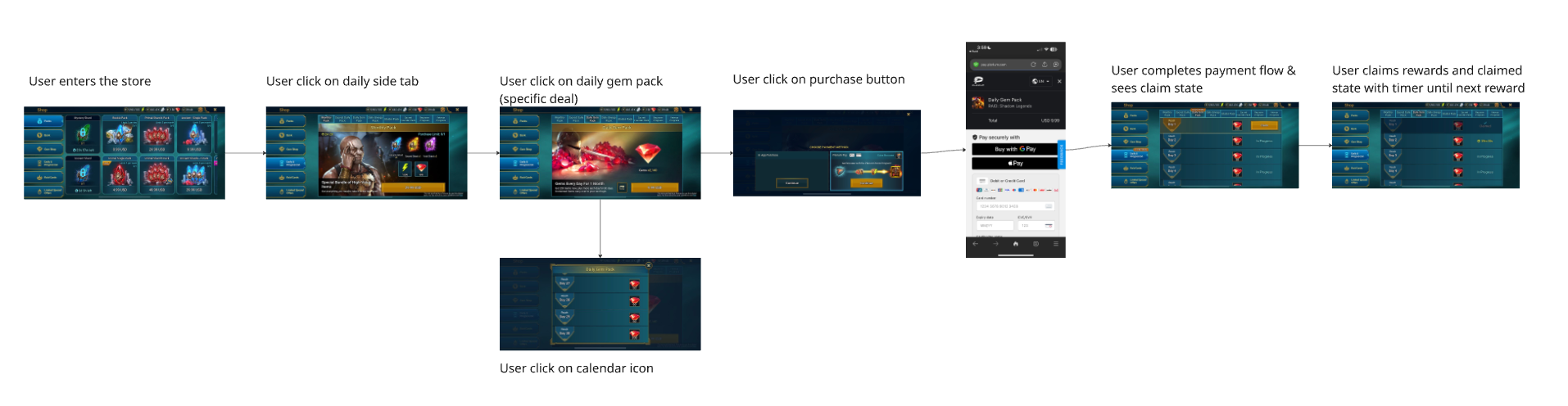
Designing games, from a product management perspective, is designing how players move through player journey states over time. This is why thinking in terms of features is rarely sufficient. Features describe what is built. Behavior describes what actually happens.
Start With the Player’s Entry State
Every system begins with a player in a specific state. That state might be emotional, mechanical, or contextual.
- Are they new or experienced?
- Are they motivated or fatigued?
- Are they returning after a loss or riding a win?
- Are they here intentionally or passively pulled in? Strong PMs work with designers to explicitly name this entry state. If you do not know where the player is starting, you cannot reason about what they should do next.
Define the Decision You Are Asking the Player to Make
Systems exist to prompt decisions.
- Play now or later.
- Spend or save.
- Push deeper or disengage.
- Retry or churn. Design clarity comes from knowing which decision matters most. When systems try to force too many decisions at once, players default to the easiest path or opt out entirely. From a product lens, this is where intent must be sharp. Vague goals produce noisy behavior.
Understand Friction as a Design Tool
Friction is not inherently bad. It is directional.
- Some friction protects pacing.
- Some friction creates mastery.
- Some friction signals value. The mistake is accidental friction. Waiting without meaning. Complexity without payoff. Confusion without resolution. PMs add value by questioning whether friction is intentional, proportional, and aligned with the desired behavior.
Reinforce Through Feedback and Reward
Every decision a player makes teaches them something based on what happens next.
- Rewards signal success.
- Feedback signals progress.
- Silence signals irrelevance. Designing behavior means ensuring that feedback is timely, legible, and consistent with the system’s intent. When rewards and feedback are misaligned, players learn the wrong lesson.
Define the Exit State and What Comes After
No system exists in isolation. Where the player exits matters as much as where they enter.
- Do they feel satisfied or pressured?
- Do they have a clear next goal or lingering confusion?
- Do they feel more invested or more exhausted? Strong PMs think beyond completion and ask what state the system leaves the player in, because that state determines future engagement.
Measuring Behavior, Not Just Outcomes
defined player journey is what makes measurement possible in the first place.
Without a clear understanding of how players enter a system, what decisions they face, where friction exists, and how they exit, metrics lose meaning. You can track numbers, but you cannot explain them. Spikes and drops become mysteries instead of signals.
This is where player journey design and outcome driven development connect.
Expected Outcomes force teams to be explicit about what behavior a system is meant to produce. They translate a designed journey into something measurable. Not because metrics define success, but because they allow you to validate whether the journey is working as intended.
From a product perspective, outcomes do not sit after design. They shape it.
Clear outcomes influence how journeys are constructed: where decisions are placed, how much friction is acceptable, what feedback is necessary, and what state the player should leave in. When outcomes are vague, journeys become unfocused. When outcomes are clear, journeys become intentional.
Measurement then becomes a feedback loop between intent and reality.
That means asking:
- Did players move through the journey the way we expected?
- Did the designed friction support or block the intended behavior?
- Did rewards and feedback reinforce the outcome we were targeting?
- Did the system meaningfully move the KPI we cared about for the right reasons?
When player journeys and outcomes are aligned, KPIs become diagnostic tools instead of goals. They tell you where the experience is breaking down and where to adjust the design.
Designing behavior deliberately is what allows measurement to stay grounded in player reality rather than drifting into abstract performance tracking.
From Philosophy to Practice
Designing games is designing behavior is not a slogan. It is a working model. It gives PMs a way to participate deeply in the design process without owning mechanics. It creates a shared language with designers. It grounds analytics in player reality. This series will continue to build on this model, expanding from individual systems to player experience over time, and finally to how UI UX communicates those systems clearly and honestly to players. This is where intentional creation begins.
In the next post, Part 2: Designing Cohesive Player Experience Across Systems, I will zoom out from individual systems and journeys to look at how player experience accumulates over time. How pacing, pressure, relief, and mastery shape engagement beyond metrics, and how PMs reason about experience curves rather than isolated features.