PM vs Live Ops: Role Clarity in Mobile Game Teams

In every live service organization, the question eventually surfaces: What is the difference between Product Management and Live Ops?
That is not the real question. The real question is this:
How should ownership of intent, operation, performance, and talent growth be architected so the game scales and so your leaders scale with it?
This is not an org chart exercise.
It determines:
- Who owns revenue performance
- Who owns player fatigue
- Who owns sequencing risk
- Who evolves the roadmap
- Who grows into your next senior leader
When this is unclear, execution feels reactive. Careers stall. Accountability blurs. When this is designed intentionally, the game feels coherent and so does the team.
Let’s start with the mental model.
The Core Framework: Intent and Operation as Dual Systems
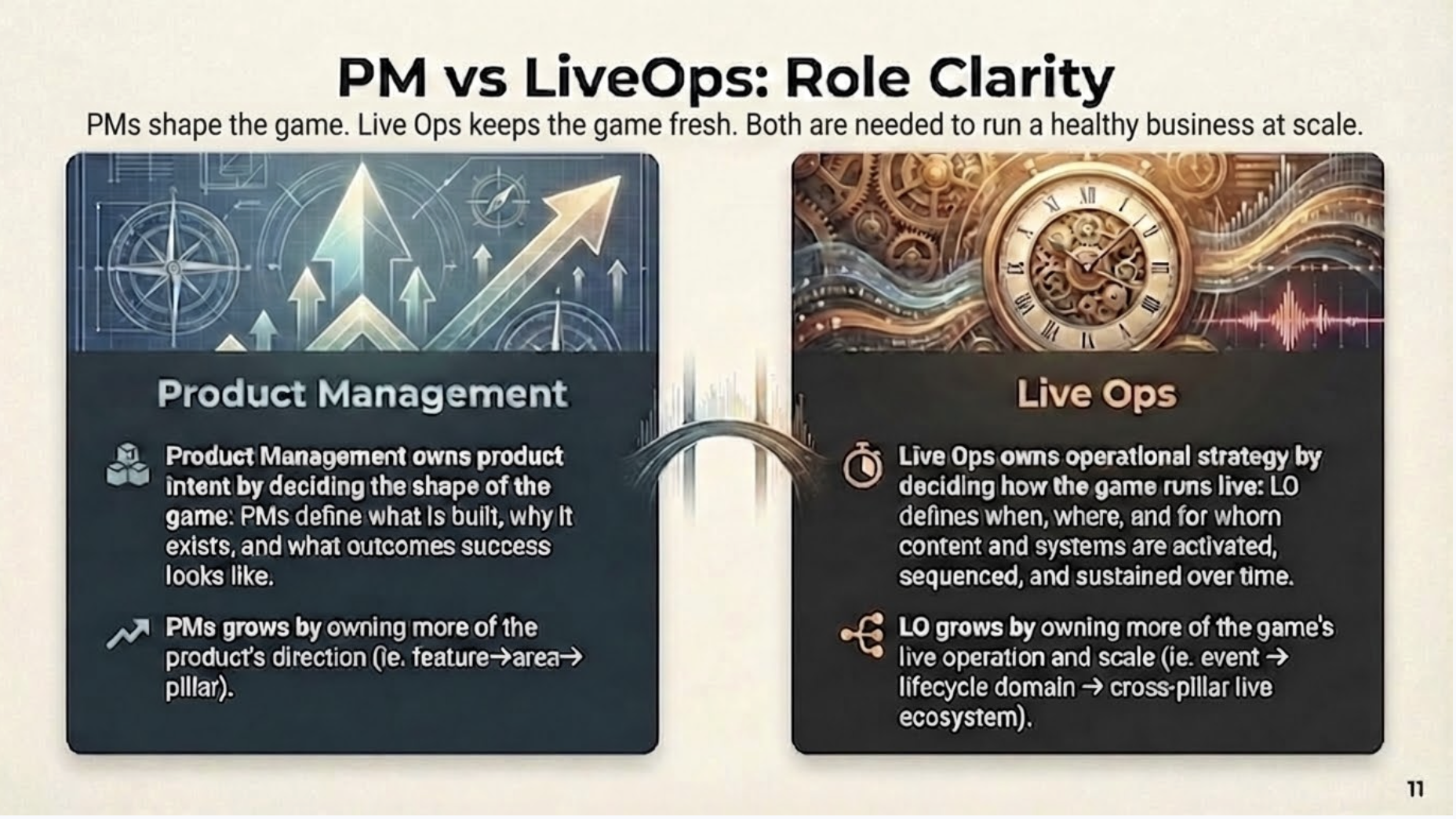
Every live service organization runs on two systems simultaneously:
- Intent: What are we building? Why does it exist? What long term player behavior are we shaping?
- Operation: When does it run? For whom? In what sequence? Under what economic pressure?
Every product organization operates both. How intent and operation are divided across roles will differ by company. There is no universally correct answer, only tradeoffs that shape how your team scales.
Model 1: Unified Ownership
In the unified ownership model, commonly seen in earlier Zynga style structures, one leader holds full lifecycle responsibility. This is effectively a mini GM model. There is no separation between Product and Live Ops. The same person is accountable for both what gets built and how it performs in live.
How It Functions
The same person:
- Defines the problem space
- Writes the specification
- Sets success metrics
- Launches experiments
- Determines activation timing
- Tunes rewards week to week
- Monitors performance daily
- Adjusts both design and cadence
There is no handoff between build and run. The loop is tight: Design → Launch → Observe → Tune → Redesign → Iterate.
Strategic Implication
This model maximizes speed and singular accountability.
It works well when:
- The team is small
- System complexity is manageable
- Leaders are comfortable operating across strategy and performance
As layering increases, the same person must simultaneously manage:
- Long term structural coherence
- Short term performance volatility
- Calendar sequencing risk
- Player fatigue management
At scale, this concentration of ownership becomes heavy.
Career Progression in Unified Ownership
Growth expands in scope:
- Feature → System → Full product surface
- Single lifecycle → Multi system orchestration
Advancement requires mastery of both architectural thinking and live performance management.
The risk is operational gravity. When too much time is spent tuning, strategic evolution slows. Leaders must intentionally protect space for long term thinking.
Model 2: Dual Strategic Tracks
Common in Scopely style portfolio organizations, this model separates intent and operation while keeping both strategic.
Product owns system architecture. Live Ops owns lifecycle architecture.
How It Functions
Using a competitive mode example:
Product decides:
- Why the mode exists
- How it integrates into the broader meta
- What metrics define success
- How it evolves within the long term roadmap
Live Ops decides:
- Launch timing relative to other events
- Segment access strategy
- Reward pacing week to week
- Seasonal cadence
- Fatigue thresholds
The loop becomes: Define → Launch → Orchestrate → Optimize → Feed insights back into roadmap.
This introduces coordination overhead but dramatically improves scalability.
Strategic Implication
This model assumes complexity.
It works best when:
- Multiple systems overlap
- Event calendars are dense
- Monetization layers are sophisticated
- Segmentation strategy is nontrivial
It requires discipline:
- Clear decision rights
- Shared dashboards
- Weekly build and live alignment
- Explicit performance accountability
Without structure, friction compounds quickly.
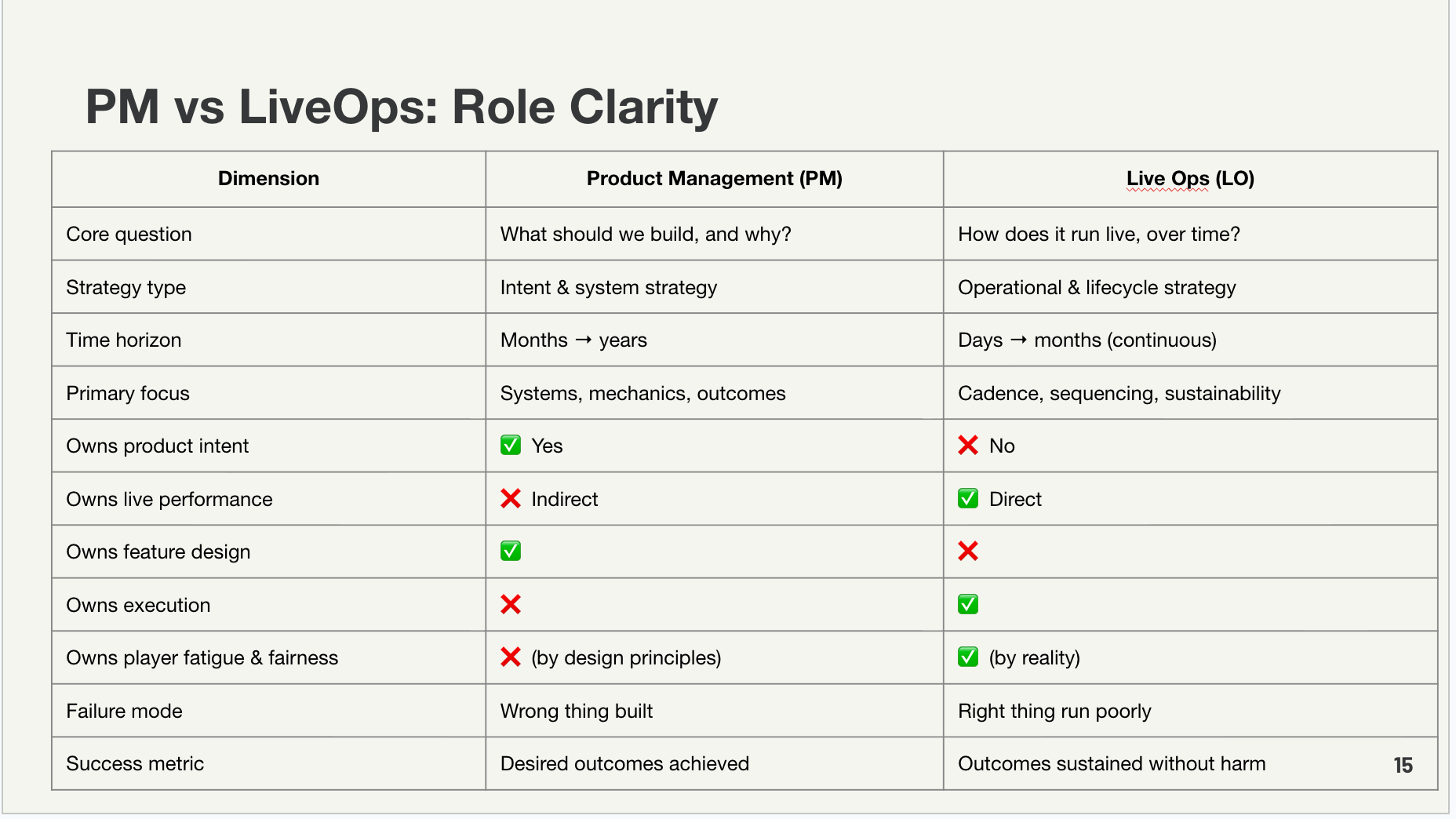
Career Progression in Dual Tracks
Product growth path:
- Feature → System → Pillar → Ecosystem coherence
Live Ops growth path:
- Event execution → Calendar ownership → Lifecycle domain → Cross pillar orchestration
Both tracks can produce senior leaders, but only if ownership is substantive.
If Product is pulled into daily execution, strategic scale stalls. If Live Ops never owns meaningful decisions, progression plateaus.
Model 3: Strategy and Execution Split
Seen in certain Jam City style structures, this model centralizes strategy within Product while Live Ops focuses primarily on execution and implementation.
How It Functions
Using the same PvP example:
Product decides:
- Why the mode exists
- Monetization framing
- Calendar placement
- Experiment design
- Graduation criteria
Live Ops:
- Configures the event in tools
- Sets reward tables per specification
- Executes activation timing
- Validates segmentation logic
The loop is linear: Define → Execute → Measure → Adjust.
Strategic authority sits primarily with Product.
Strategic Implication
This model optimizes operational efficiency.
It works when:
- Systems are mature
- Calendar strategy is stable
- Execution volume is high
- Consistency is prioritized over experimentation autonomy
It struggles when live iteration requires rapid strategic judgment.
Career Progression in This Model
Product growth requires:
- Deep metric fluency
- Strong specification discipline
- Clear performance accountability
Live Ops growth requires intentional expansion beyond tooling into decision influence.
If execution never evolves into influence, a ceiling forms. If Product never delegates operational depth, scalability suffers.
The Career Architecture Test
Organization design is ownership design. Career progression is embedded in what people are trusted to own. If you want a team that produces senior leaders, you must design roles that expand meaningfully over time.
Ask ownership questions, not title questions:
- What decisions expand as this person becomes more senior?
- What metrics are they accountable for at each level?
- What tradeoffs are they trusted to resolve?
- What cross functional influence increases with scope?
In a unified model, progression should mean broader lifecycle and performance ownership.
In a dual track model, progression should mean deeper strategic authority within a defined lane.
In an execution focused model, progression must deliberately introduce decision making power or the role caps out.
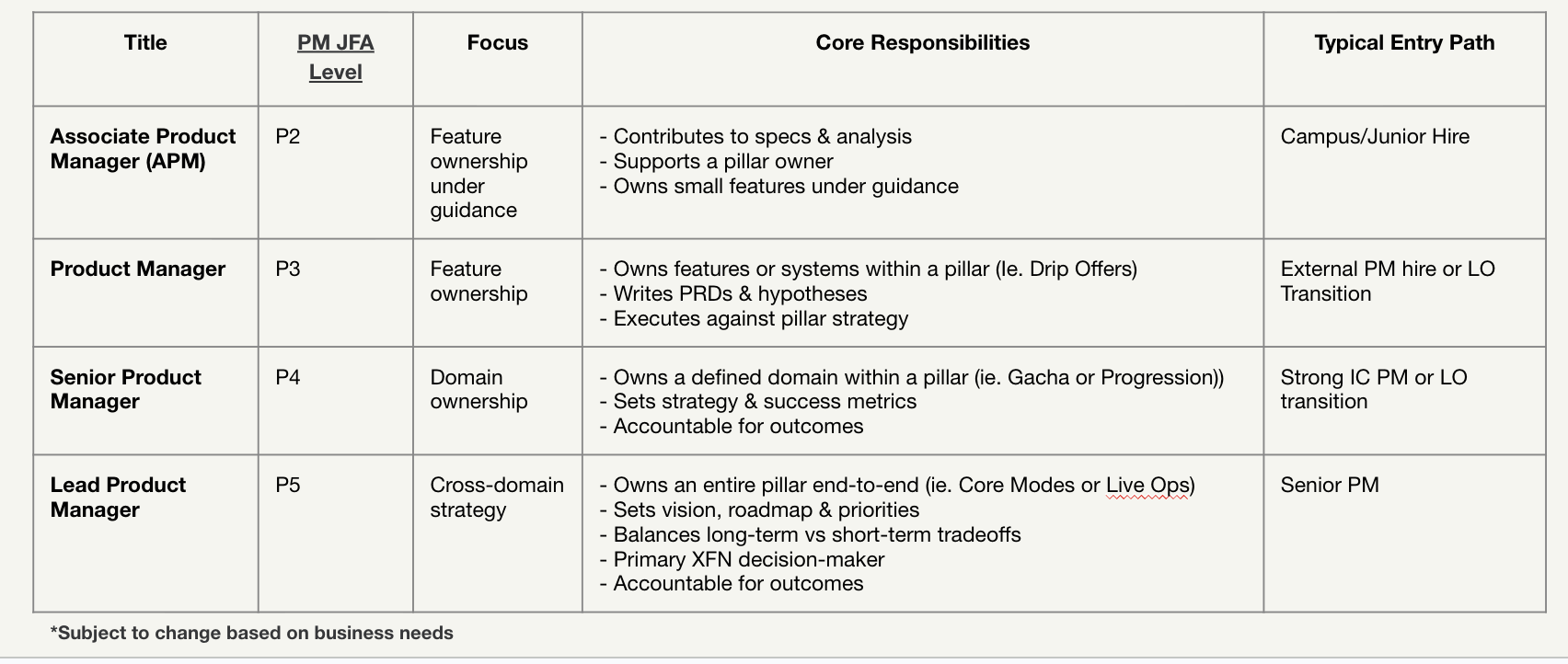
Design around three layers of ownership:
- Surface ownership: execution and delivery
- System ownership: strategy and tradeoffs within a domain
- Ecosystem ownership: cross system alignment and performance accountability
If someone cannot move from surface to system to ecosystem ownership, you have designed a ceiling.
If someone is given ecosystem visibility without system accountability, you have designed fragility.
Ownership clarity is career clarity.
Role Mobility and Job Architecture
Designing ownership is only half the equation. The other half is enabling movement.
In mature organizations, people will eventually want to move between tracks. A PM may want to move into Live Ops. A Live Ops leader may want to move into Monetization or System Strategy. If your job architecture does not support this, you create invisible walls.
Mobility must be intentional.
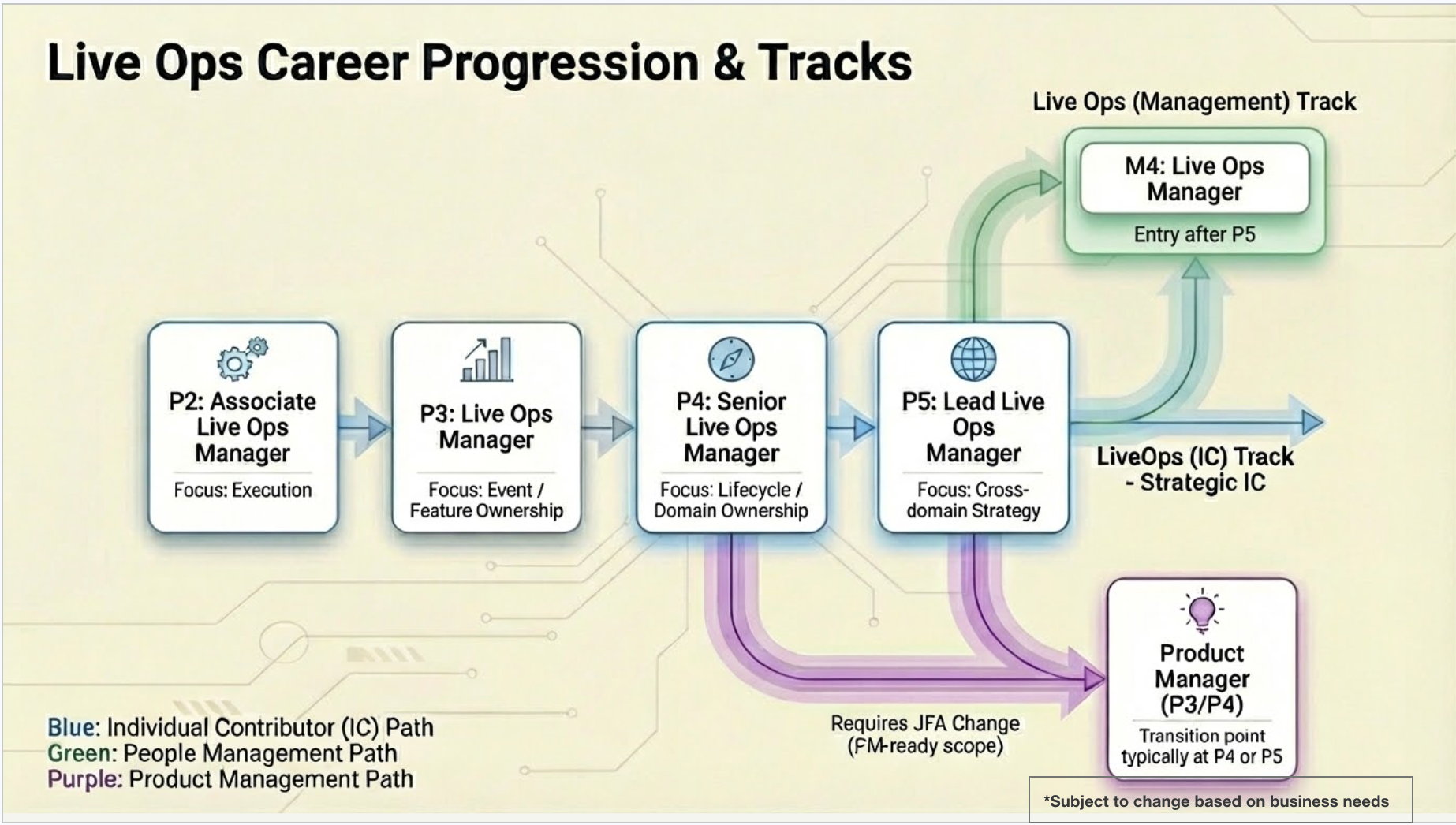
First, clarify equivalency.
If Product and Live Ops are parallel strategic tracks, levels must be aligned in scope and impact. A Senior Live Ops PM should carry ecosystem ownership comparable to a Senior PM. If one track is structurally narrower, lateral movement will feel like a demotion.
Second, define transition criteria in terms of ownership, not titles.
If someone wants to move tracks, ask:
- Have they demonstrated system ownership beyond execution?
- Have they shown metric fluency across both earn and spend dynamics?
- Have they resolved cross functional tradeoffs independently?
- Have they operated at ecosystem level, not just surface level?
Movement should follow demonstrated ownership at the next layer, not tenure.
Third, partner with HR early.
Job architecture should reflect:
- Clear scope definitions for each level
- Distinct competency expectations by track
- Explicit ownership expansion across levels
- Documented pathways for lateral movement
If HR frameworks lag behind how the game actually operates, progression conversations become subjective. Align role definitions with how ownership truly works in practice.
Finally, create structured exposure.
If you want mobility between tracks:
- Rotate ownership of specific initiatives
- Assign cross calendar projects
- Share performance readouts across lanes
- Allow temporary shadow ownership during major launches
People cannot transition into roles they have never been allowed to practice.
Healthy organizations design permeability between tracks while preserving clarity within them.
Mobility without ownership clarity creates chaos. Ownership clarity without mobility creates stagnation.
Closing: If You Are Facing This Right Now
If you are reading this because your team feels misaligned, overloaded, or politically tense, the problem is likely not effort.
It is ownership.
When Product and Live Ops friction feels personal, it is usually structural. When calendar debates feel endless, decision rights are unclear. When careers stall, scope has stopped expanding.
This is not solved by better communication alone. It is solved by redesigning what each role truly owns.
Start here:
- Write down who owns intent.
- Write down who owns lifecycle orchestration.
- Write down who owns live performance in practice.
- Write down how ownership expands at each level.
If you cannot answer those clearly in a few sentences, your team cannot operate clearly either.
Ownership is the operating system of a live service organization.
If you design it intentionally, alignment becomes structural instead of emotional. If you leave it ambiguous, friction becomes personal and scale becomes fragile.
The structure of your team will become the structure of your decisions. And the structure of your decisions will become the structure of your game.
Design deliberately.


